

What Is Algorithmic Trading and How Does It Work in India?
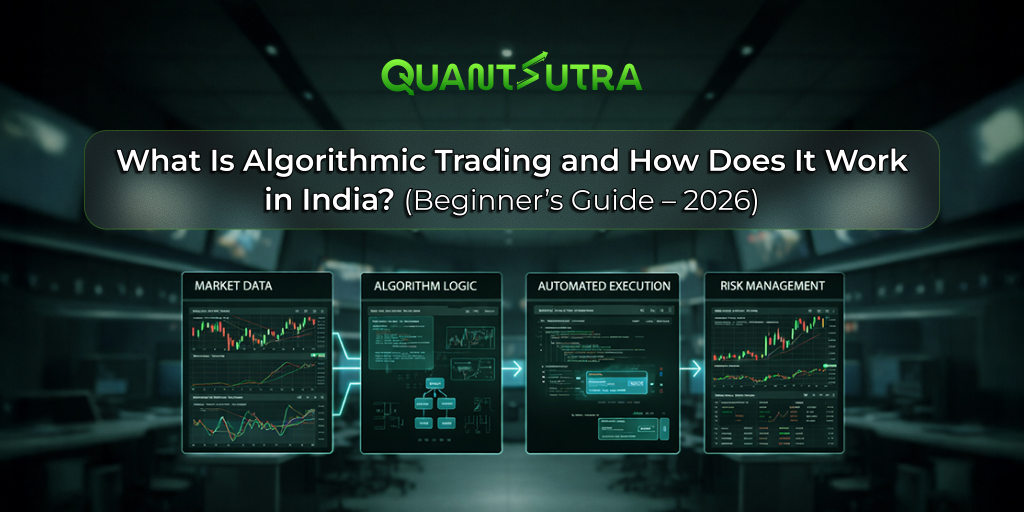
Have you ever wondered how trades get executed in milliseconds faster than any human can click a button?
Or how some traders manage to follow strict discipline every single time, without emotions taking over?
That’s where algorithmic trading comes in.
Algorithmic trading is no longer limited to hedge funds or big institutions. In India, retail traders are increasingly adopting algorithmic trading platforms to automate strategies, reduce emotional mistakes, and trade more systematically.
- But what exactly is algorithmic trading?
- How does it actually work in India?
- And is it legal and safe for retail traders?
So, without any further ado, let’s break it down clearly, practically, and without jargon.
What Is Algorithmic Trading?
Algorithmic trading is the process of executing trades automatically using predefined rules and logic without manual intervention.
In simple words:
- You define what to trade, when to trade, and how much to trade
- The system executes those trades automatically for you
These rules can be based on:
- Price movements
- Technical indicators
- Time based conditions
- Risk limits
- Market behavior patterns
Once the logic is set, an algorithmic trading software places orders automatically exactly as instructed.
How Is Algorithmic Trading Different From Manual Trading?
Here’s a quick reality check.
Manual trading relies on | Algorithmic trading relies on |
Human Judgment | Rule based logic |
Emotions (fear and greed) | Zero emotional bias |
Delayed execution | Fast execution |
Inconsistent discipline | Consistent stratefy application |
That’s why algorithmic trading is becoming popular among traders who want structure, discipline, and scalability.
How Does Algorithmic Trading Work in India? (Step by Step)
But,
How does algorithmic trading actually work in the Indian market?
Here’s the real flow
1. Strategy Creation
The trader defines a strategy using clear rules:
- Entry conditions
- Exit conditions
- Stop loss
- Position sizing
This can be done using algorithmic trading software or a no code algo trading platform.
2. Strategy Approval & Compliance
In India, algorithmic trading is regulated by SEBI. Strategies must be routed through compliant brokers and exchanges.
Retail traders are allowed to use automated trading platforms, as long as:
- Orders are placed through approved APIs
- Risk checks are in place
- The platform follows exchange guidelines
3. Live Market Monitoring
Once deployed, the algorithm:
- Continuously monitors live market data
- Checks if conditions match your strategy rules
- Prepares orders instantly when conditions are met
4. Automated Order Execution
When conditions align:
- Orders are placed automatically
- No manual clicking required
- Execution happens at market speed
This is where algorithmic trading platforms add massive value speed + precision.
5. Risk Management & Monitoring
Good algorithmic trading software includes:
- Pre defined risk limits
- Quantity caps
- Price filters
- Kill switch mechanisms
This ensures safety even during volatile market conditions. But
Is Algorithmic Trading Legal in India?
Yes, algorithmic trading is legal in India.
SEBI allows algorithmic trading for both institutions and retail traders, provided:
- Trades are routed via registered brokers
- APIs are approved
- Risk controls are implemented
What’s not allowed is:
- Unregulated black box systems
- Unauthorized market manipulation
- Bypassing broker or exchange controls
This is why choosing the right algorithmic trading platform is critical.
What Types of Algorithmic Trading Are Used in India?
Here are some commonly used approaches:
- Rule Based Trading – Strategies based on indicators like moving averages, RSI, breakouts, etc.
- Time Based Trading – Orders placed at specific times (open, close, VWAP based execution).
- Trend Following Algorithms – Strategies that ride trends and exit when momentum fades.
- Arbitrage & Spread Strategies – Exploiting price differences across instruments or markets.
Most modern automated trading platforms support these strategies in a simplified, rule-based format.
What Role Do Algorithmic Trading Platforms Play?
Here’s a question worth asking:
Can you do algorithmic trading without a platform? Technically yes but practically, no.
An algorithmic trading platform acts as the bridge between:
- Your strategy logic
- Market data
- Broker APIs
- Order execution
- Risk controls
A good platform simplifies:
- Strategy creation
- Testing & validation
- Live deployment
- Monitoring & reporting
Where Does QuantSutra Algo Trading Platform Fit In?
The QuantSutra algo trading platform is designed specifically for traders who want:
- Structured automation
- No unnecessary complexity
- Practical, real world execution
Instead of forcing traders to code, QuantSutra focuses on:
- Rule based strategy logic
- Clean execution workflows
- Trader friendly automation
- Compliance ready architecture
This makes QuantSutra a strong choice for traders exploring algorithmic trading in India especially those transitioning from manual trading.
Know more at www.quantsutra.com
Why Algorithmic Trading Is Growing So Fast in India?
Let’s be honest Indian markets are:
- Highly volatile
- Emotionally driven
- Fast moving
Algorithmic trading helps traders:
- Remove emotional decision making
- Maintain discipline
- Execute strategies consistently
- Trade even when they’re not actively watching screens
That’s why algo trading platforms are no longer optional they’re becoming essential tools.
Conclusion
Algorithmic trading in India is no longer a future concept it’s already shaping how modern traders operate.
With the right algorithmic trading platform, traders can:
- Trade with discipline
- Reduce emotional errors
- Scale strategies systematically
- Focus on logic, not impulses
If you’re looking to start or scale your journey in algorithmic trading, platforms like QuantSutra make automation practical, accessible, and trader friendly without unnecessary complexity.
Explore more at www.quantsutra.com
Frequently Asked Questions
Yes. QuantSutra is designed with simplicity in mind, offering ready-to-use models and an intuitive dashboard suitable for traders of all skill levels.
Yes. Retail traders can legally use algorithmic trading through SEBI compliant brokers and platforms.
Not necessarily. Many modern algorithmic trading platforms are designed for non coders.
Software refers to the underlying system, while an algo trading platform provides user friendly tools to create, deploy, and monitor strategies.
Like all trading, it carries risk. However, automated systems reduce emotional mistakes and improve consistency when used responsibly.